
📖 Table of Contents
- What Is Minoxidil
- How Does It Work
- Member’s Mark vs Kirkland
- How to Apply Minoxidil (Step-by-Step)
- Benefits
- Factors Affecting Minoxidil
- Side Effects of Minoxidil
- Minoxidil VS Other Hair Loss Treatments
- Who Should Use It
- Can Women Use Minoxidil
- Alternative To Minoxidil For Hair Growth
- FAQ
- Shipping Minoxidil Worldwide
- Warnings And Side Effects
- Disclaimer
I see hair-loss frustration all the time, you notice extra shedding in the shower, your hairline or crown looks thinner, and your confidence takes a hit. You want something real, not a magic promise, and minoxidil is usually one of the first options people consider because it’s widely available and researched. The big decision is simple: how do you use minoxidil correctly so you give it a fair shot, without wasting months doing it wrong?
In this guide, we’ll cover:
- What minoxidil is, and who it’s typically for
- How minoxidil works in plain English, plus what we still don’t fully know
- Exactly how to apply minoxidil step-by-step, including timing and dosing
- What benefits you might see, and what timeline is realistic†
- Side effects, warnings, and how to reduce avoidable problems†
Ready to buy Minoxidil? Here’s what’s commonly in stock on Same Day Supplements:

What Is Minoxidil
Minoxidil is a medication that researchers originally developed to treat high blood pressure, then they noticed a surprise side effect during trials, hair growth. That discovery pushed minoxidil into the hair-loss world, and the FDA approved it as a topical medication for hair loss treatment. (1)
Today, you can find it over-the-counter in many places, and some versions exist by prescription too. People most often use it for male and female pattern baldness. Results can vary and it won’t work for everyone, so I always tell people to treat it like a trial you run correctly, not a guarantee.†
You’ve also got to use minoxidil exactly as directed and give it time, because it can take several months before you can judge whether it’s helping you.† (2)
How Does Minoxidil Work
Minoxidil is a vasodilator, think of it like opening a kinked garden hose so more water can pass through. In medical terms, a vasodilator widens blood vessels and increases blood flow. When you apply it to your scalp, that widening effect can increase blood flow to hair follicles, which may improve delivery of oxygen and nutrients.† (1,2,3)
That increased support can help stimulate hair growth and may help keep hairs in the growth phase longer.† In hair terms, you’re trying to keep follicles active rather than letting them miniaturize and shut down.†
Minoxidil also seems to act directly on the follicle. It activates potassium channels in hair follicles, which relates to changes at the cell membrane level and involves calcium ions, that signaling may stimulate follicles toward growth.†
On top of that, research suggests minoxidil may have an anti-inflammatory effect on the scalp. In plain terms, it may help calm some local irritation processes that can be part of hair loss.†
One important reality check, scientists still don’t fully agree on the exact mechanism in every detail. I like to frame it as a “multi-lever” product: improved blood flow, follicle signaling, and reduced inflammation probably all contribute to the effect.†
Foam vs. Liquid: Which One Should You Choose
Both forms use the same active ingredient, minoxidil. The difference is how it feels on your scalp and how easy it is to apply consistently, and consistency is what usually drives results.†
Foam (5%)
- Dries quickly
- Less chance of scalp irritation because it typically doesn’t use propylene glycol
- Easier to apply if you’ve got short hair or a sensitive scalp
Liquid/Solution (5%)
- Usually cheaper
- The dropper can make precise scalp placement easier
- May feel greasier and can sometimes cause redness or dryness†
Quick clarification: Effectiveness is generally considered comparable between foam and solution in the research, so this choice usually comes down to comfort, scalp sensitivity, and budget.†
Member’s Mark vs Kirkland
I get this question constantly because most guys don’t want to overpay for the same active ingredient. The practical truth is simple: both Member’s Mark and Kirkland use the same active and the same listed inactive ingredients, so the decision usually comes down to availability, price, and which one you’ll actually use consistently.†
At-a-glance: if you’re treating typical crown thinning (vertex), either one can be a solid pick, as long as you stick to 1 mL twice daily and give it months, not weeks.†
- Active ingredient: Minoxidil 5% (both)†
- Inactive ingredients: Alcohol, propylene glycol, purified water (both)
- Use case: Men’s vertex thinning (top of scalp), not frontal hairline/receding hairline†
| Feature | Member’s Mark Minoxidil | Kirkland Minoxidil Extra Strength |
|---|---|---|
| What it is | Hair regrowth treatment for men with general thinning on the top of the scalp (vertex only). | Topical Solution USP, 5% hair regrowth treatment for men with general thinning on the top of the scalp, not for frontal baldness or receding hairline.† |
| Active ingredient | Minoxidil 5% | Minoxidil 5% |
| Inactive ingredients | Alcohol, propylene glycol, purified water | Alcohol, propylene glycol, purified water |
| How to use | Apply 1 mL with dropper 2 times a day directly onto the scalp in the hair loss area. Using more or more often won’t improve results, and you’ll need continued use to keep regrowth.† | Apply 1 mL with dropper 2 times a day directly onto scalp in the hair loss area. Using more or more often won’t improve results, and continued use is necessary to keep regrowth.† |
| Results timeline (typical label guidance) | Results may be seen as early as 2 months with twice daily use, some men need at least 4 months.† | Results may occur at 2 months.† |
| Who shouldn’t use it | Not for women, not for frontal scalp hair loss, not for sudden/patchy loss, not under 18, skip if scalp is inflamed or you use other scalp medicines.† | Not for women, not intended for frontal baldness or receding hairline, skip if sudden/patchy loss, not under 18, skip if scalp is inflamed or you use other scalp medicines.† |
So which one should you choose?
If your scalp handles propylene glycol fine and you want a straightforward 5% solution, you can pick based on price and what’s in stock. If you’ve had irritation before, don’t assume one will be magically different, both list alcohol and propylene glycol, so you may want to consider a foam format instead.†
Coach’s insight: The “best” minoxidil is the one you’ll use twice a day for at least 4 months. If you’re not the type who’ll stick to that, save your money and fix the routine first.†
Member’s Mark Minoxidil quick profile
Member’s Mark Minoxidil Solution is a hair regrowth treatment for men who have general thinning on the top of the scalp (vertex only), and it’s described as comparable to men’s Rogaine “extra strength.”†
The active ingredient is Minoxidil 5%. The inactive ingredients are alcohol, propylene glycol, purified water.
Kirkland Minoxidil quick profile
Kirkland Minoxidil Topical Solution USP, 5% is a men’s hair regrowth treatment for general thinning on the top of the scalp, and it’s not intended for frontal baldness or a receding hairline.†
The active ingredient is Minoxidil 5%. The inactive ingredients are alcohol, propylene glycol, purified water.
How to Apply Minoxidil (Step-by-Step)
Getting the best results from minoxidil usually comes down to using it correctly and not missing days. Here’s the daily process I’d follow if you want to remove guesswork and stay consistent.†
- Start with a dry scalp, make sure your hair and scalp are completely dry before applying.
- Measure the dose, use the dropper to apply 1 mL of solution, or use half a capful of foam.
- Apply to thinning areas, gently rub into the scalp where hair is thinning, not the hair itself.
- Wash your hands after use, this helps prevent the solution from spreading to other areas.
- Let it dry fully, wait at least 2 to 4 hours before shampooing, swimming, or going to bed.
- Stay consistent, apply twice daily, morning and evening, because skipping doses can slow or stop progress.†
Tip: More isn’t better. Using extra minoxidil won’t speed up growth, but it can raise your odds of irritation and side effects.†
Benefits
Here’s how I break down the real-world benefits people look for with minoxidil. These are the common outcomes studied in androgenetic alopecia, and your response can vary person to person.† (1,2,3)
- Regrowing Hair: One of the main reasons people use minoxidil is to support regrowth. Studies show it can help regrow hair in men and women with androgenetic alopecia, which is the most common form of hair loss.†
- Improve Hair Density: Research suggests minoxidil can improve hair density in men and women with androgenetic alopecia. Results vary, and it often takes several months of consistent use before changes are noticeable.†
- Slowing Down Hair Loss: Minoxidil can also help slow down loss for some people by supporting follicles, partly through improved scalp blood flow. In practice, people often notice less shedding over time when they stick with it.†
I’m always upfront about this: minoxidil isn’t a miracle cure for hair loss. It tends to work best as part of a complete plan that supports your overall health, like nutrition, exercise, and other hair support strategies that a healthcare professional recommends.†
Factors Affecting Minoxidil’s Effectiveness
Minoxidil can be effective, but it’s not plug-and-play. A handful of real-life factors can change how well you respond, and knowing them helps you set expectations and use it smarter.† (4,5)
- Age: Minoxidil tends to be more effective in individuals under 40, since follicles can become less responsive to growth stimulants as we age.†
- The severity of hair loss: It’s typically most effective for mild to moderate hair loss. With advanced hair loss or full baldness, it may not have much follicle activity left to work with.†
- Length of time with hair loss: The longer follicles have been inactive, the harder it can be to reactivate them, so response can drop the longer you’ve been thinning.†
- Use of other hair loss treatments: Some people pair minoxidil with other approaches like finasteride, and that combo may increase effectiveness for certain users.†
- Consistency of use: This is a big one. You’ve got to use minoxidil consistently and as directed, because skipping doses can reduce effectiveness.† (5)
- Genetics: Family history can influence how well you respond. Some people with strong hereditary pattern loss simply don’t respond as well as others.†
What Results Should You Expect?
Patience matters here, and I know that’s not what you want to hear when you’re watching hair fall. Minoxidil is a long game, so you’re looking for trends over months, not day-to-day changes.†
- Months 1 to 3, you may see increased shedding. That can be normal, old hairs can make way for new ones.†
- Months 4 to 6, you may start seeing visible signs of growth, like fine new hairs and less noticeable thinning.†
- 6+ Months, thickening can continue with ongoing use, and consistency is critical for long-term results.†
Important: If you stop using minoxidil, the new growth will gradually be lost. I want you to think of it like a maintenance treatment, staying consistent is the secret.†
Side Effects of Minoxidil
Most people tolerate topical minoxidil well, and serious side effects aren’t common. Still, side effects can happen, especially if you overuse it or you’re sensitive to the formula.† (1,2,4,5)
Here are the most common side effects people report:
- Scalp irritation: Itching, redness, and dryness can happen, especially with solutions that use propylene glycol.†
- Increased hair shedding: Early shedding can happen in the first weeks. It can be part of the hair cycle shift and isn’t automatically a bad sign.†
- Hair growth in unwanted areas (Hypertrichosis): Rarely, hair can grow in places other than the scalp, like the face or neck, usually from transfer or sensitivity.†
- Dizziness: Since minoxidil is a vasodilator, some people may experience a blood-pressure drop and feel dizzy.†
- Chest pain: Rarely, chest pain or discomfort can occur and may signal a serious cardiovascular issue. If this happens, you should stop and get medical attention.†
In many cases, side effects are mild and can fade with continued use. Still, if you get severe or persistent symptoms, don’t try to tough it out, get medical attention. Overuse can increase side-effect risk and usually won’t add benefit.†
Minoxidil VS Other Hair Loss Treatments
Several hair loss treatments are available on the market, including prescription medications and over-the-counter products. Here, we will compare Minoxidil to some of the most common hair loss treatments.
- Finasteride: Finasteride is a prescription medication that works by blocking the production of dihydrotestosterone (DHT), a hormone that can contribute to hair loss. While both Minoxidil and Finasteride are effective treatments for hair loss, they work in different ways. Minoxidil stimulates hair growth by increasing blood flow to the hair follicles, while Finasteride works by blocking DHT production. (6)
- Hair transplant surgery: Hair transplant surgery involves taking hair follicles from a donor area on the scalp and transplanting them to areas with thinning or balding hair. While hair transplant surgery can provide long-lasting results, it is also more expensive and invasive than Minoxidil or other topical treatments. (7,8)
- Natural remedies: Many natural remedies and supplements are marketed as treatments for hair loss, such as biotin and saw palmetto. While some of these remedies may have anecdotal evidence to support their effectiveness, there is limited scientific research to confirm their benefits. Minoxidil is backed by decades of research and is one of the few hair loss treatments that are FDA-approved. (9,10,11)
- Lustriva® (supplement ingredient): A patented complex (bonded arginine silicate + magnesium biotinate) used in beauty “from within” products; early data suggests fuller/thicker-looking hair over weeks, mainly studied in women; ideal for customers wanting a daily supplement add-on. Marketed for hair thickness/quality via nutrient support and structural benefits; not a drug.†
“The right comparison isn’t ‘which one is strongest,’ it’s ‘which one matches the mechanism I need.’ If your issue is crown thinning, topical minoxidil is often a logical first lever. If your issue is strongly DHT-driven, you may also look at DHT-focused strategies with a clinician.”†
Overall, minoxidil is one of the most researched and commonly used options, and it’s usually easier and more affordable than procedures. If your hair loss is severe or advanced, you might get better coverage by combining it with other treatments like finasteride or considering transplant surgery.†
Who Should Use Minoxidil
Minoxidil is usually recommended for people dealing with hair loss or thinning from androgenetic alopecia, also called AGA. Think of AGA like a “follicle shrink” pattern, follicles gradually miniaturize and eventually stop producing strong hairs.
Both men and women use minoxidil, and it comes in different strengths like 2% and 5% solutions and foams. It’s usually more effective when you start early, so if you’re noticing thinning or shedding, it’s often better to act sooner than later.† (1,2,4,5)
Even though it’s generally safe for many people, some groups should be cautious or skip it completely. Here are the key groups called out most often in guidance and precautions:
- Pregnant or breastfeeding women
- Individuals with scalp irritation or sunburn, since minoxidil can irritate the scalp, wait until your skin heals
- Individuals with a history of heart disease, since minoxidil can lower blood pressure and that can be risky†
- Anyone with a known allergy to minoxidil or an ingredient in the formula should talk with a healthcare professional first†
Bottom line, minoxidil can be a safe and effective option when you use it correctly. You still want to pay attention to side effects and contraindications, and if you’re unsure whether it fits your situation, a clinician can help you choose the safest route.†
Can Women Use Minoxidil
Yes, women can use minoxidil, and it’s a common treatment for female pattern hair loss. Clinical studies show minoxidil can help women regrow hair, especially for androgenetic alopecia, which is the most common cause of hair loss in women. (1,)
One study found that 52% of women with AGA who used a 5% minoxidil solution for 48 weeks showed significant improvement in hair growth, compared to 11% using placebo. Another study found increases in hair density after six months of use.† (12,13)
Here are practical tips I’d give women who want to use minoxidil safely and consistently. These focus on application habits that reduce irritation and improve adherence.†
- Choose the right strength: Women commonly use a 2% minoxidil solution, while men often use 5%. Higher strength can increase side effect risk.†
- Apply to dry scalp: Make sure your scalp is dry before applying. You can towel dry or use a hair dryer to fully dry hair and scalp.†
- Apply twice a day: Apply to the affected scalp area twice daily, ideally morning and night.†
- Use the dropper to apply the solution: Apply directly to the scalp, then spread evenly over the affected area.†
- Massage into the scalp: Massage with fingertips for about 1 minute after applying to help distribute and support absorption.†
- Wash your hands: Wash hands thoroughly after application so you don’t spread product to other areas.†
- Allow the solution to dry: Let it dry completely before styling hair or going to bed.†
- Be patient: It can take several months of consistent use to see results, don’t quit early if you’re not seeing fast changes.†
If you’re pregnant, breastfeeding, or you’ve got a medical condition that complicates topical medications, I’d loop in a healthcare professional before starting. That’s not me dodging the question, it’s how you stay safe with a real drug product.†
Alternative To Minoxidil For Hair Growth
Natural hair supplements are a popular alternative for people who don’t want a prescription-style approach, or who want an add-on to a topical routine. These usually include vitamins, minerals, and nutrients tied to healthy hair structure, like biotin, vitamins C and E, and iron. The research is limited and sometimes conflicting, some studies show benefits and others show no meaningful change.† (9,10,11)
It is important to note that these alternatives have not been studied as extensively as Minoxidil, and their effectiveness may vary from person to person.
There are several alternatives you could utilize for hair growth, including:
Biotin:
Biotin is a B vitamin that is essential for hair growth. It can be taken as a supplement or found in certain foods, such as eggs, nuts, and salmon.†
Vitamin D:
Vitamin D plays a role in hair follicle growth and can be found in foods like fatty fish, egg yolks, and mushrooms. It can also be taken as a supplement.†
Iron:
Iron is an important mineral for hair growth, as it helps to carry oxygen to the hair follicles. A deficiency of Iron is a common cause of hair loss, so supplementing with iron may help to promote hair growth.†
Zinc:
Zinc is important for healthy hair growth and may help to prevent hair loss. It is found in oysters, red meat, and pumpkin seeds but can also be supplemented.†
Saw Palmetto:
Saw palmetto is an herbal supplement that is commonly used to treat hair loss in men. It works by blocking the production of DHT, a hormone that can contribute to hair loss.†
Omega-3 fatty acids:
Omega-3 fatty acids are important for overall hair health and may help to reduce inflammation and promote hair growth. They are found in fatty fish, walnuts, and chia seeds but can also be supplemented.†
L-Arginine:
L-arginine is an amino acid important for blood flow and can promote hair growth. It can be found in foods like meat, fish, and dairy products or as a supplement.†
Peppermint oil:
Peppermint oil has been shown to promote hair growth and can be applied topically to the skin. To avoid irritation, diluting peppermint oil before applying it to the skin is important.†
Coconut oil:
Coconut oil is a natural moisturizer that can help keep the skin and hair healthy. It can be applied topically to the skin to promote hair growth.†
Pumpkin Seed Oil:
Pumpkin seed oil is another natural remedy that is believed to be effective in treating hair loss. It is derived from pumpkin seeds, which are rich in nutrients such as vitamins A, K, and E, as well as zinc and omega-3 fatty acids, all of which are important for healthy hair growth. Studies have shown that pumpkin seed oil may effectively treat hair loss, particularly in cases of androgenetic alopecia.†
Rosemary Oil:
Rosemary oil is a popular natural remedy for hair loss and is believed to work by stimulating blood flow to the scalp and promoting hair growth. Studies have shown that rosemary oil may effectively treat hair loss, particularly in androgenetic alopecia, the most common form of hair loss in both men and women.†
FAQ
This is where I’ll hit the questions I get the most about minoxidil, including beard use, results, and annoying side effects like greasy hair. Some of these uses are off-label, so I’ll be direct about what’s approved and what isn’t.†
Can I Use Minoxidil For My Beard? |
|---|
| Minoxidil is often used off-label by men who want to increase beard density or promote beard growth. It’s not FDA-approved for face or beard use, so you should approach it cautiously and ideally under guidance from a healthcare professional.†
If you use it on your beard, apply only where you want growth and keep it away from your eyes and other facial areas. Skin irritation can happen, so starting with a small amount and increasing slowly can help you gauge tolerance.† |
How to use Minoxidil for beard growth? |
If you’ve decided to use minoxidil for beard growth, using a consistent process helps you reduce side effects and judge results. Here are the steps that people usually follow:
|
Are Minoxidil And Rogaine The Same? |
| Minoxidil and Rogaine are essentially the same in the sense that minoxidil is the active ingredient, and Rogaine is a brand name product that contains it. So yes, Rogaine is basically a branded minoxidil.†
Other brands of Minoxidil include the following:
|
Are Results Permanent? |
| Minoxidil results typically aren’t permanent. It can stimulate hair growth and increase follicle size, which improves thickness and density, but stopping use usually leads to fading effects over time.†
How long results last varies a lot. Some people hold onto gains longer, and others see thinning return relatively quickly once they stop.† Minoxidil is a maintenance treatment, so you’ve got to stay consistent to maintain benefits. If you stop, hair loss may resume and regaining benefits can take months or more.† |
Can It Cause Acne? |
| Yes, acne can happen as a side effect. It may relate to increased blood flow plus topical ingredients that can contribute to clogged pores for some people.†
To lower the risk, stick to the recommended amount and don’t overapply. Keeping the scalp clean and avoiding pore-clogging hair products can also help.† |
Can It Cause Headaches? |
| Headaches are rare, but they can occur. The exact cause isn’t fully understood, but it may relate to effects on blood pressure and blood flow.† |
Does It Weigh Your Hair Down Or Make Hair Greasy? |
| If you use the liquid solution, it can make hair look greasy or weighed down for some people. That’s often tied to ingredients like propylene glycol, which can feel oily or slick.†
Not everyone gets this effect. Some people actually feel like their hair looks thicker and fuller, possibly from improved scalp blood flow and better follicle activity.† To reduce greasiness, use it sparingly and apply only when scalp and hair are completely dry. A gentle sulfate-free shampoo and avoiding heavy styling products can also help.† |
Shipping Minoxidil Worldwide
Shipping Minoxidil worldwide is a common concern for those who want to use this product but reside in a different country. While Minoxidil is available over the counter in many countries, some areas are not easily accessible. For example, in Canada, Minoxidil 2% is available for purchase without a prescription. However, higher dosages, such as 5%, require a prescription. The good news is that according to The Drug and Health Product Register, Minoxidil imports to Canada are exempt when sold in preparations for topical use in concentrations of 5% or less. (14) Additionally, at Same Day Supplements, we ship worldwide.
I still recommend checking with your country’s Customs office before ordering. If your Customs team needs specific declaration wording, label formatting, or other documentation, it’s better to have that ready before the order ships.†
Looking for more information about importing supplements? Check out our international pages! Or contact us here.
Wrapping Up!
And this marks the end of our post on Minoxidil. Thank you for reading! And as always, if there was something that wasn’t clear, another question you might have, or if you have another idea for a blog, Email Us!
Are you looking for more to read? Check out some of our other blogs!
- Tricaprin, Caprylic Acid, and MCT Oil Supplements
- Natural Testosterone Boosters Guide
- What Is Whey Protein?
- Glutamine: What Does It Do And Should You Start Taking It?
- Can Collagen Improve Hair, Skin, And Nail Health? (Guide)
- Best Keto Supplements in 2024
- Best Hangover Supplements
- Building Muscle for Women
Warnings And Side Effects
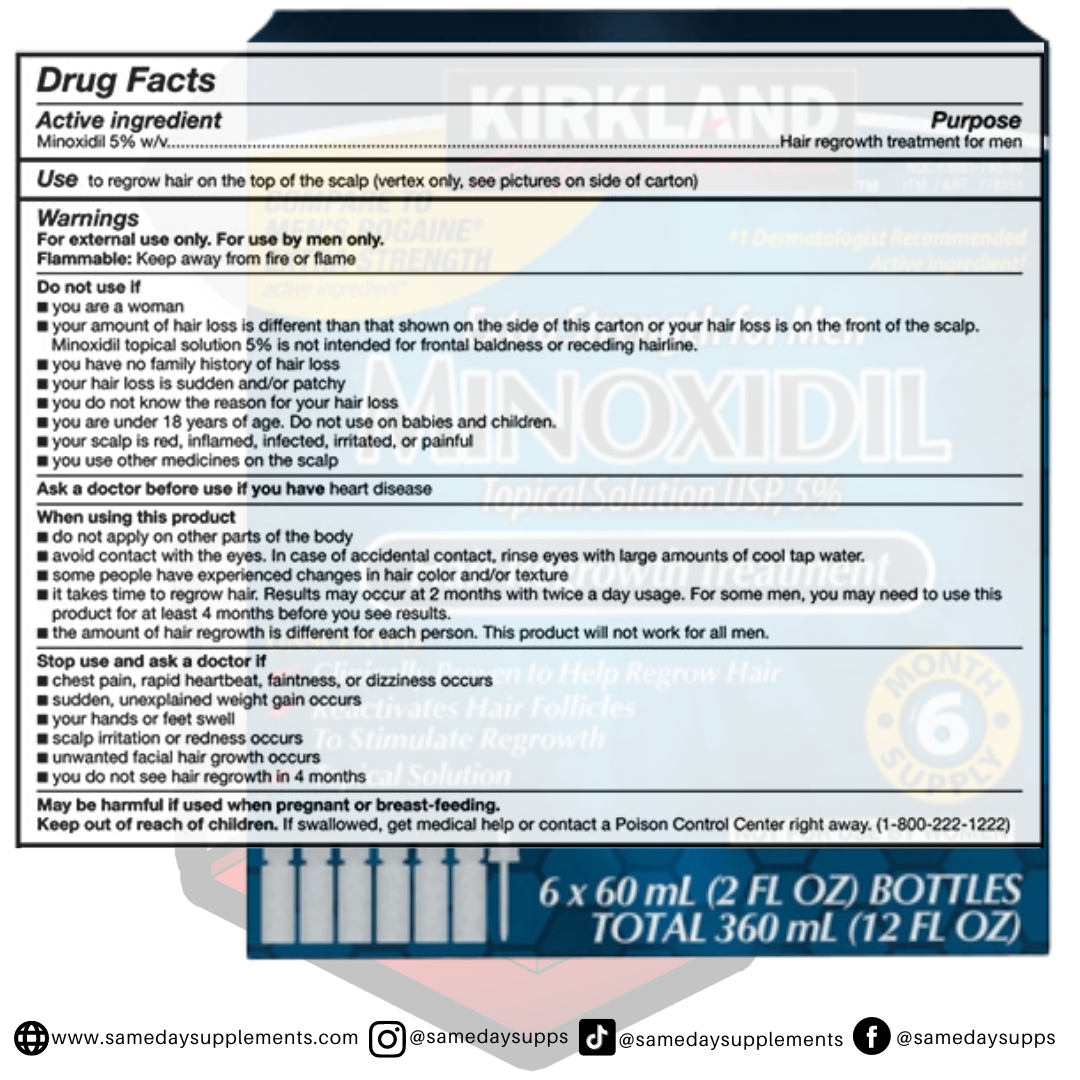
For external use only. For use by men only. Flammable: Keep away from fire or flame.
It may be harmful if used when pregnant or breastfeeding. Keep out of reach of children. If swallowed, get medical help or contact a Poison Control Center immediately. Stop using and ask a doctor if:
- Chest pain, rapid heartbeat, faintness, or dizziness occur
- Sudden, unexplained weight gain occurs
- Your hands or feet swell
- Scalp irritation or redness occurs
- Unwanted facial hair growth occurs
- You do not see hair regrowth in 4 months
Products in this blog are not manufactured or distributed by Johnson and Johnson Healthcare Products, Men’s Rogaine Extra Strength distributor.
Disclaimer
† Same Day Supplements is a dietary supplement retailer and digital publisher. We do not provide personal medical advice, diagnosis, treatment, or emergency health services. If you are experiencing a medical emergency, contact your local emergency services or go to the nearest emergency room or urgent care center immediately.
The content on this blog, including text, graphics, images, product comparisons, ingredient discussions, customer experiences, and other materials, is provided for general educational and informational purposes only. It is not intended to replace professional medical advice, diagnosis, treatment, or guidance from a qualified healthcare provider.
You should consult your physician or another qualified healthcare professional before starting any supplement, diet, exercise, fitness, or wellness program, especially if you are pregnant or nursing, under 18, taking medication, have a medical condition, are sensitive to stimulants, have a history of high blood pressure or heart concerns, or are subject to athletic drug testing.
Our blog content may include product label information, manufacturer-provided details, published research, anecdotal customer feedback, and Same Day Supplements editorial interpretation. Any product discussion or recommendation is intended to help readers compare supplement options and should not be interpreted as medical advice or a guarantee of results.
Individual results may vary. Same Day Supplements makes no guarantee regarding the effectiveness, safety, suitability, or results of any product, ingredient, supplement stack, or wellness approach discussed on this site. Product formulas, labels, warnings, serving sizes, ingredients, availability, and regulatory status may change without notice. Always read the full product label before use and follow the manufacturer’s directions and warnings.
Information about ingredients, health conditions, medications, interactions, side effects, allergies, and precautions may not include every possible use, risk, warning, or adverse effect. If you have questions about whether a product is appropriate for you, consult a qualified healthcare provider before use.
Statements made about dietary supplements have not been evaluated by the Food and Drug Administration. Dietary supplements are not intended to diagnose, treat, cure, or prevent any disease.
This disclaimer supplements and is part of the Same Day Supplements website Terms & Conditions, Privacy Policy, and other posted policies and conditions of use.